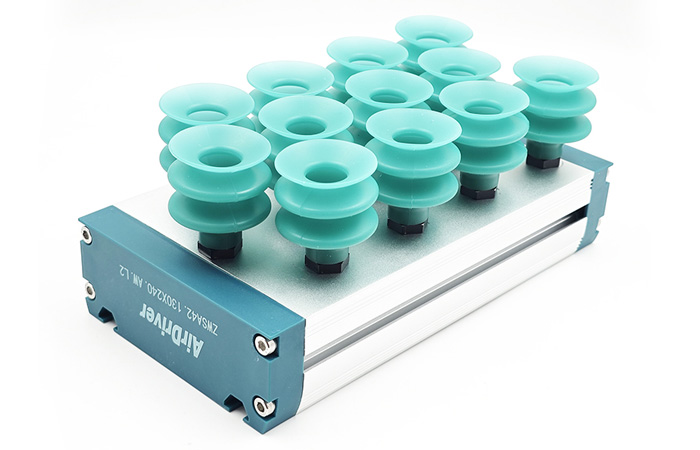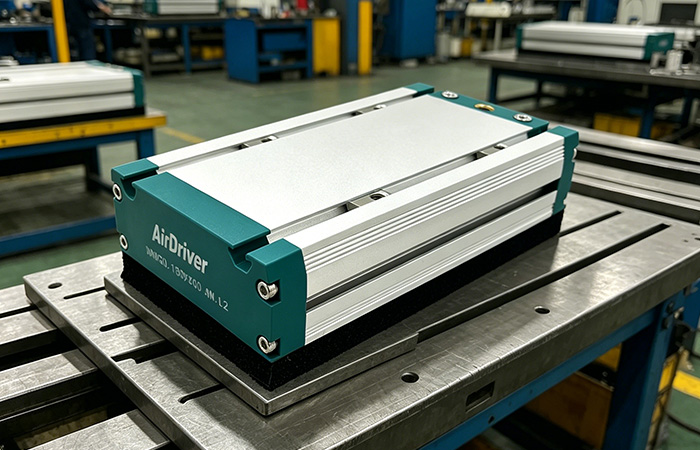


Advantages of vacuum gripper technology come down to a simple question for every automation buyer: how do you move more parts per hour, with fewer damaged products and less downtime? A vacuum gripper is an end-of-arm tool (EOAT) that uses negative pressure to lift, hold and release a workpiece, and in modern factories it has become the default choice for pick-and-place, palletizing, case packing and machine tending.
In this guide, the AirDriver technical team breaks down the seven vacuum gripper advantages that matter most in industrial automation, explains how a pneumatic vacuum gripper generates holding force, and gives you a practical framework for selecting the right unit for your line. Whether you are integrating a new robot vacuum gripper or replacing mechanical jaws on an existing cell, the same seven factors drive the return on investment.
Most plants do not struggle with whether to automate. They struggle with the tooling. Mechanical grippers add weight, need precise part positioning, and can mark or deform sensitive surfaces. Vacuum end-of-arm tooling removes most of those constraints: it grips from one side only, adapts to shape variation, and releases cleanly without pinch points.
That is why vacuum handling now appears in packaging lines, food processing plants, e-commerce fulfillment centers, electronics assembly and metal stamping cells. According to industry data published by the International Federation of Robotics, record numbers of industrial robots are being installed every year, and end-of-arm tooling is consistently one of the highest-impact decisions in those projects. A gripper that is too heavy, too slow, or too fragile quietly caps the throughput of the entire robot.
The sections below cover the seven advantages in the order a procurement or engineering team usually evaluates them: flexibility, product protection, efficiency, robot integration, running cost, application range, and customisation. Each section includes the practical detail you need to justify the decision internally.
Below are the seven advantages that consistently show up in automation ROI calculations. We have ranked them from the shop-floor benefit you notice first (flexibility) to the one that protects you long term (customisation).
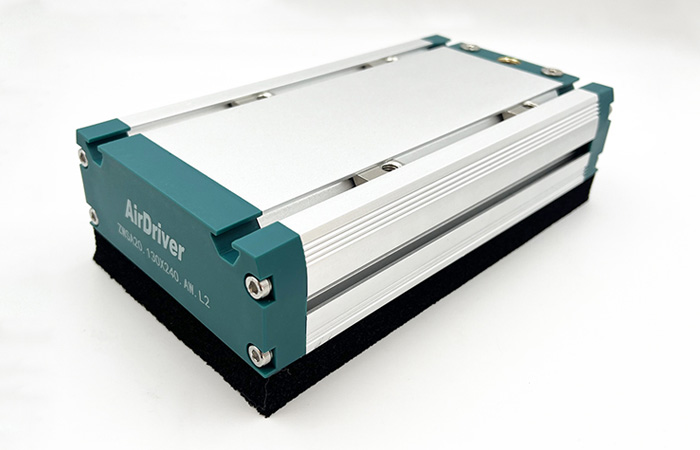
A well-specified vacuum gripper is a platform, not a single-purpose tool. Change the suction cup geometry or the cup layout, and the same body handles cartons, trays, film-wrapped packs, glass panels and moulded plastic parts. For lines running mixed SKUs or seasonal packaging, that flexibility removes the cost of a dedicated mechanical jaw per product.
Cup selection is what makes this work. Flat cups suit smooth, rigid surfaces. Bellows cups (1.5-fold and 2.5-fold) compensate for height differences and uneven surfaces. Oval cups handle long, narrow parts. Foam or sponge pads seal against porous, textured or irregular shapes such as woven sacks and baked goods.
| Workpiece Type | Recommended Cup | Why It Works |
|---|---|---|
| Flat cartons, glass, sheet metal | Flat cup, NBR or silicone | Maximum sealing area and holding force on smooth surfaces |
| Uneven or curved surfaces, height variation | Bellows cup, 1.5 or 2.5 fold | Fold design absorbs level differences and acts as a spring |
| Narrow strips, profiles, tubes | Oval cup | Long sealing lip fits restricted contact areas |
| Woven bags, porous or textured goods | Foam / sponge pad | Seals across leakage paths where rigid cups cannot hold vacuum |
| Multiple small parts per cycle | Multi-cup array on a common plate | One robot cycle picks a full layer or a full tray |
The practical outcome: changeovers become a cup swap instead of a tool design project. If you are standardising cup interfaces across several cells, start with a custom vacuum suction cup family so that one mounting thread size covers every station.
Mechanical jaws concentrate force at two or three contact points. Vacuum distributes holding force evenly across the whole suction area, which is exactly what fragile finished goods need. The result is fewer scratches on glass and polished metal, no crushing of soft packaging, and no deformation of thin-walled mouldings.
Product protection is usually the fastest payback in the business case. On a line running cosmetic parts or display panels, reducing the reject rate by even a fraction of a percent often covers the tooling cost within a few months, before any labour savings are counted.
Safety matters just as much. A vacuum gripper has no external clamping fingers, so the pinch risk around the tool is lower, and the robot cell is easier to validate against ISO 10218 and ISO/TS 15066 requirements. Modern assemblies also add a one-way check valve and a vacuum switch: if the compressed-air supply drops, the check valve holds vacuum on the workpiece for a short period, and the switch triggers a controlled stop instead of an uncontrolled drop.
Vacuum builds in milliseconds, and release is equally fast when the ejector blow-off is used. Compared with a mechanical stroke that has to open, approach, close and confirm, a vacuum pick is essentially instant at the moment of contact, which compresses every cycle.
Two design factors multiply that gain. First, vacuum tooling is light: an aluminium plate with cups and a compact ejector often weighs far less than an equivalent parallel or angular gripper, so the robot can accelerate harder and the axis wears less. Second, area gripping lets one cycle move several parts, or an entire layer, instead of a single item.
Consistency is the third benefit. Because the grip does not depend on precise part positioning, the cell tolerates normal variation in infeed presentation. That means fewer mispicks, fewer recovery routines, and less time spent re-teaching positions after a packaging change.
Integration is where many automation projects lose weeks. Vacuum tooling keeps it simple mechanically, pneumatically and electrically. Mechanically, the tool mounts on a standard ISO 9409-1 flange pattern, so it bolts directly to six-axis robots, SCARA units, delta pickers, gantries and collaborative robots from ABB, Fanuc, KUKA, Yaskawa, Universal Robots, Techman and Doosan.
Pneumatically, most plants already have a compressed-air network. An ejector-based pneumatic vacuum gripper needs a single supply line and an exhaust; there is no separate vacuum pump cabinet to install and no additional electrical cabinet load. Electrically, the interface is minimal: one digital output to switch vacuum on and off, one digital input for the vacuum-level or part-present signal, plus a blow-off signal if needed.
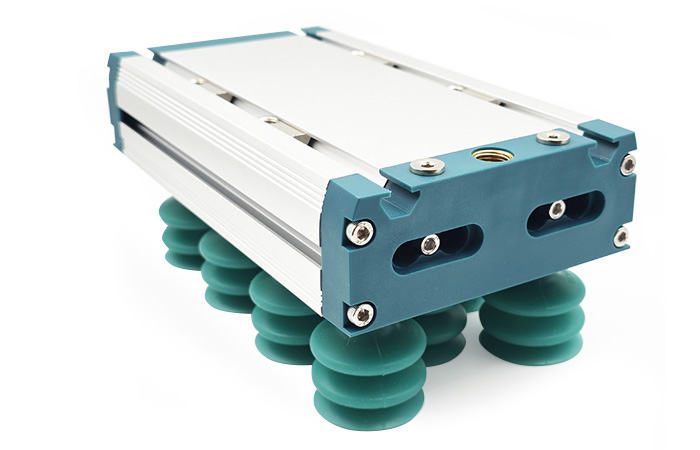
For collaborative applications the weight budget is the deciding factor, and this is where a compact unit with a built-in generator wins. A ZWSA robot arm vacuum gripper combines the cups, the vacuum generator and a one-way check valve in one body, so a cobot with a 5 kg or 10 kg payload keeps most of its capacity for the product instead of spending it on the tool.
Planning a new robot cell? AirDriver supplies ISO-flange vacuum gripper assemblies with built-in generators and standard I/O, so integration is a bolt-on job. Send us your robot model, payload and workpiece drawing, and our engineers will return a mounting and cup layout proposal.
A mechanical gripper has jaws, guides, gears or linkages, and most of them need periodic lubrication and re-adjustment. A vacuum gripper has very few moving parts: the wearing element is the suction cup lip, which is a low-cost consumable that an operator can replace in minutes without recalibrating the tool.
Energy cost is often overlooked. An ejector only consumes compressed air while it is generating vacuum, and air-saving generator designs with a vacuum switch stop the supply once the target level is reached. That intermittent duty cycle is usually cheaper to run over a year than a continuously running electric vacuum pump, especially on cells with idle periods.
Condition monitoring is the hidden saving. A vacuum switch or digital pressure sensor flags slow vacuum build-up, which is the earliest symptom of a worn cup, a blocked filter or a leaking fitting. Maintenance becomes a planned five-minute cup change at a shift boundary rather than an unplanned stop in the middle of production. Standardising on one cup family across the plant also shrinks the spare-parts inventory you need to hold.
Vacuum handling is not a niche technique. It appears anywhere a product has at least one reasonably flat, non-porous region that a cup or foam pad can seal against, and modern cup materials have pushed that boundary much further than it was a decade ago.
| Industry | Typical Workpieces | Typical Gripper Configuration |
|---|---|---|
| Packaging and cartoning | Cartons, trays, shrink-wrapped packs | Flat or bellows cup array on a lightweight plate |
| Food and beverage | Bags, pouches, baked goods, trays | Food-grade silicone cups or washdown-rated foam gripper |
| Logistics and warehousing | Parcels, totes, sacks, mixed-SKU goods | Area-gripping foam pad for unknown shapes |
| Electronics and display | PCBs, screens, glass panels | Non-marking, anti-static cups with low contact pressure |
| Automotive and metal | Sheet metal, stampings, moulded trim | Bellows cups with spring-mounted level compensators |
| Plastics processing | Injection-moulded parts, sprues | High-temperature cups for take-out robots |
| Wood, glass and stone | Panels, slabs, sheets | Large-diameter cups sized with a high safety factor |
Bag and sack handling deserves a special mention. Woven polypropylene and paper sacks leak air continuously, so rigid cups lose vacuum almost immediately. A foam pad solves the problem by sealing across the whole contact area, which is why a ZWSB woven bag robot gripper is specified for rice, corn, feed and bulk-material palletizing.
Catalogue tooling covers perhaps 70 percent of applications. The remaining 30 percent is where a custom design pays for itself: an unusual part geometry, a very short cycle time, a washdown environment, or a robot with almost no payload to spare.
A customisation project usually starts from these variables:
For OEM machine builders and system integrators, the commercial side matters as much as the engineering: drawing approval, a validated sample, documented cup spare-part numbers, and a supply commitment for the life of the machine. AirDriver’s pneumatic vacuum gripper range is built for exactly that model, from a single prototype tool to repeat production volumes.
Standard tooling not a fit? Send your workpiece drawing, weight, cycle-time target and robot model. AirDriver engineers will propose a cup layout, generator sizing and mounting interface, and quote both the prototype and the production quantity.
Work through the following checks in order. Each one eliminates a set of options, and by step six you will have a specification a supplier can quote against without a round of follow-up questions.
The table below gives the theoretical pull-off force of a single round cup at -60 kPa. Use it for a first sizing pass only; always apply the safety factor and the friction coefficient for the real handling direction.
| Cup Diameter | Theoretical Force At -60 kPa | Equivalent Pull-Off Mass | Typical Use |
|---|---|---|---|
| 20 mm | 18.8 N | 1.9 kg | Small electronic parts, vials |
| 30 mm | 42.4 N | 4.3 kg | Small cartons, pouches |
| 40 mm | 75.4 N | 7.7 kg | General packaging pick-and-place |
| 60 mm | 169.6 N | 17.3 kg | Case packing, tray handling |
| 80 mm | 301.6 N | 30.7 kg | Sheet metal, panel handling |
| 100 mm | 471.2 N | 48.0 kg | Large cartons, sacks |
| 125 mm | 736.3 N | 75.1 kg | Glass and stone slabs |
| 150 mm | 1060.3 N | 108.1 kg | Heavy panel and slab handling |
Note the friction correction. The figures above apply to a perpendicular pull-off. If you lift a part by its vertical face, the usable force is roughly the holding force multiplied by a friction coefficient of 0.3 to 0.6, depending on whether the surface is dry, oily or dusty. That is why vertical handling usually needs more cups rather than more vacuum.
For a step-by-step walkthrough with worked examples, see our robot vacuum gripper selection guide.
Vacuum grippers are used in packaging and cartoning, food and beverage processing, logistics and e-commerce fulfilment, electronics assembly, automotive and sheet-metal handling, plastics injection moulding, wood and glass processing, and pharmaceutical packaging. Any application that needs repeatable, non-marking handling of a part with at least one sealable surface is a candidate.
Yes. Vacuum grippers are one of the most common robot end-of-arm tools because they mount on standard ISO 9409-1 flanges, weigh far less than mechanical grippers, and need only a compressed-air line plus one or two digital signals. They work with six-axis industrial robots, SCARA and delta pickers, gantries, and collaborative robots with limited payload.
It can, provided the suction cup interface is standardised. Swapping cup type, size and layout lets one gripper body move cartons, trays, bags, panels and moulded parts. For highly mixed or unknown products, an area-gripping foam pad handles almost any shape without a changeover, which is why it is popular in parcel handling.
Typical materials include cardboard and corrugated board, plastic packaging and film, glass, sheet metal, painted and coated panels, wood and MDF panels, stone and ceramic slabs, PCBs and display panels, bags and sacks made of paper or woven polypropylene, and food products such as baked goods and trays. The limiting factor is surface porosity, not material type.
A pneumatic vacuum gripper generates vacuum with a venturi ejector: compressed air accelerates through a nozzle, creating a low-pressure zone that draws air out of the suction cup. The pressure difference between ambient air and the vacuum inside the cup presses the workpiece against the cup lip. Holding force equals the vacuum level multiplied by the sealed cup area.
The seven vacuum gripper advantages covered here all point in the same direction: flexible handling across mixed SKUs, gentle contact that protects finished surfaces, shorter cycle times, straightforward robot integration, lower maintenance and running cost, a wide application range, and a customisation path when standard tooling falls short. For most industrial automation projects, that combination is why vacuum beats mechanical gripping on total cost of ownership rather than on purchase price alone.
If you are comparing options today, start with the workpiece data and the safety factor, then work outward to the robot interface and the air supply. And when you shortlist partners, judge them on cup availability and documentation as much as on the unit price; our guide on how to evaluate vacuum gripper suppliers covers the questions worth asking.
Ready to specify your next gripper? AirDriver manufactures pneumatic vacuum grippers, suction cups and vacuum generators, with custom cup layouts and OEM supply for machine builders and integrators. Send your application details and receive a sizing proposal and quotation.
About the author: The AirDriver technical team designs and supplies pneumatic vacuum gripper systems, suction cups and vacuum generators for OEM machine builders and system integrators. The specifications and sizing figures in this article reflect our standard product data and typical field configurations; final selection should always be validated against your own workpiece and safety requirements.