

Food packaging operations are being squeezed from three directions at once: persistent labour shortages on packing lines, shorter production runs with far more SKUs, and hygiene audits that get stricter every year. When these projects run into trouble, the robot is rarely the problem. The end-of-arm tooling is.
A robot vacuum gripper is the interface that decides whether a pouch, tray, carton or bulk bag survives the transfer at line speed without scuffing, tearing, slipping or slowing the cycle. Unlike a mechanical clamp, it holds a package with negative pressure distributed across a gripping surface, which is why vacuum-based end-of-arm tooling now dominates secondary and tertiary food packaging: case packing, tray loading, cartoning, top loading and palletising.
This guide is written for packaging engineers, automation integrators and procurement teams. It explains where a robot vacuum gripper fits in food packaging automation applications, how to integrate one into an existing line, which failure modes cost the most downtime, and when a custom vacuum gripping system pays for itself.
Key takeaways
In practical terms, a robot vacuum gripper is an assembly of four elements: a gripping face (suction cups or a foam pad), a manifold or frame, a vacuum source, and sensing. All four have to be specified together. A perfectly sized cup on an undersized vacuum generator will still drop product, because the generator cannot evacuate the leakage fast enough.
One clarification matters for compliance: in most food packaging automation the gripper handles the packaging — film, board, tray or bag — not the food itself. Food-contact materials are only required where the gripper touches unwrapped product, such as bakery items or fresh produce. Getting this right avoids both over-specifying cost and under-specifying compliance.
The table below maps the most common food packaging formats to the gripping approach that works in production. It is the fastest way to sanity-check a tooling specification before you request a quote.
| Packaging Format | Main Handling Challenge | Recommended Gripping Approach |
|---|---|---|
| Flow-wrap and pillow pouches (snacks, confectionery) | Film shifts, seal area is uneven, pack is very light | Multi-bellows silicone cups, soft lip, short stroke compensation |
| Stand-up pouches and doypacks | Flexible body, gusset, moving centre of gravity | Twin-cup or wide-footprint bellows cups on separate vacuum circuits |
| Cartons and sleeves (frozen food, bakery multipacks) | Porous board, paper dust, print scuffing | Flat PU or NBR cups, high-flow generator, vacuum line filter |
| Trays and thermoformed packs (meat, ready meals) | Wet or greasy rim, rigid but slippery surface | Silicone cups with drainage grooves, higher safety factor on area |
| Woven PP and paper bulk bags (rice, flour, sugar) | Porous surface, heavy load,high dust load | Foam vacuum gripper with large sealing area and check valve zoning |
| Unwrapped bakery and fresh produce | Deformable product, food-contact requirement | Food-grade silicone or foam face at very low contact pressure |
Almost no real line runs a single format. That is the underlying reason the gripper specification — not the robot specification — usually determines changeover time and therefore overall equipment effectiveness.
Integration is where most budget is won or lost. The three sub-systems below are the ones that generate callbacks: mechanical and robot compatibility, vacuum generation and air supply, and the pick-and-place sequence itself.
Start with the payload budget, not with the cup. Robot rated payload must cover gripper mass plus product mass plus vacuum components, and still leave margin for acceleration. Underestimating this is the single most common cause of dropped packs on a line that tests fine at low speed.
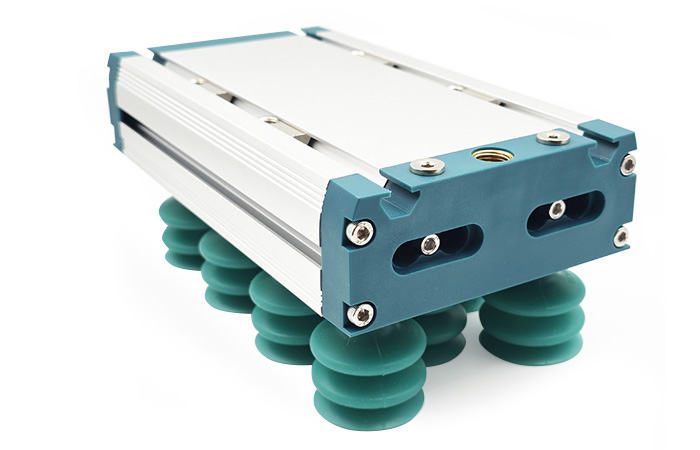
There are three ways to generate vacuum on a packaging cell, and the choice depends on the load. A pneumatic ejector, also called a vacuum generator, is compact, fast and mounts directly on the tool, which keeps vacuum lines short and response times low. A central vacuum pump or blower suits large-area foam grippers and porous loads with continuous leakage. An electric vacuum generator fits collaborative robots or mobile units where compressed air is not available.
A reliable pick-and-place cycle is six defined steps. Teams that skip the verification and release steps are the ones chasing intermittent drops for months.
| Step | What Happens | What To Specify |
|---|---|---|
| 1. Approach | Robot descends to pick height | Bellows stroke or spring stems to absorb pack height tolerance |
| 2. Seal and evacuate | Vacuum builds to the switch threshold | Measure evacuation time; do not assume it |
| 3. Verify | Sensor confirms vacuum is achieved | Retry or divert logic, instead of dropping at speed |
| 4. Transfer | Robot accelerates and decelerates | Acceleration limited by holding force and friction |
| 5. Place and release | Controlled venting, then separation | Short blow-off pulse for film and lightweight packs |
| 6. Return | Tool resets for the next pick | Cup face check interval and cleaning routine |
Planning a robot vacuum gripper retrofit?
AirDriver engineers review robot payload, air supply and pick geometry before quoting, so the gripper you receive matches the cell you actually run. Send your pack drawings, weights and target cycles per minute.
Three problems account for the majority of vacuum gripper downtime on food lines: difficult packaging materials, slip and vacuum loss, and hygiene-driven wear. Each has a specific engineering answer.
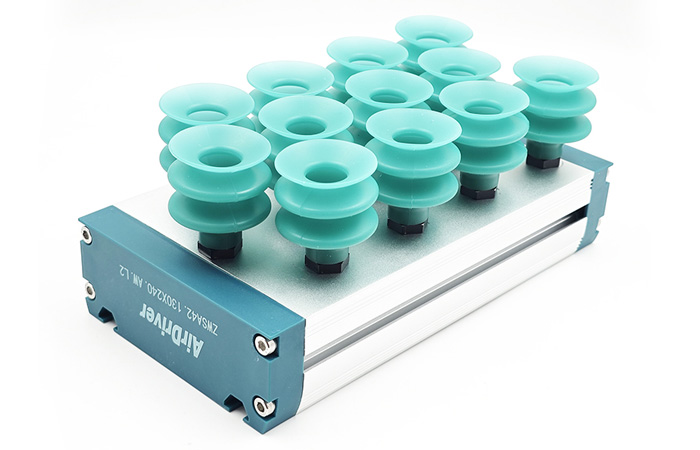
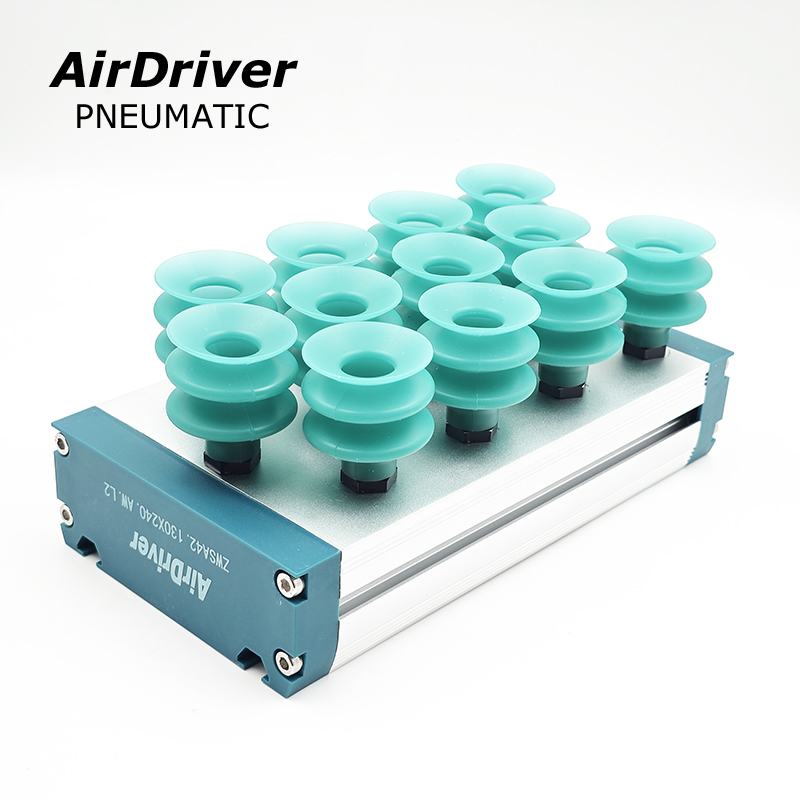
Flexible film does not behave like a rigid part. The film lifts and folds locally before the cup can seal, so the cup chases the material instead of holding it. The fix is geometry and speed: soft, thin-lip bellows cups with stroke compensation, and a reduced approach speed at the moment of contact.
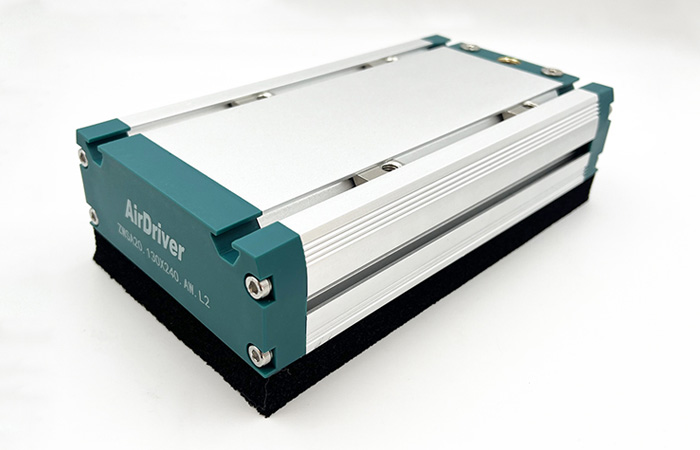
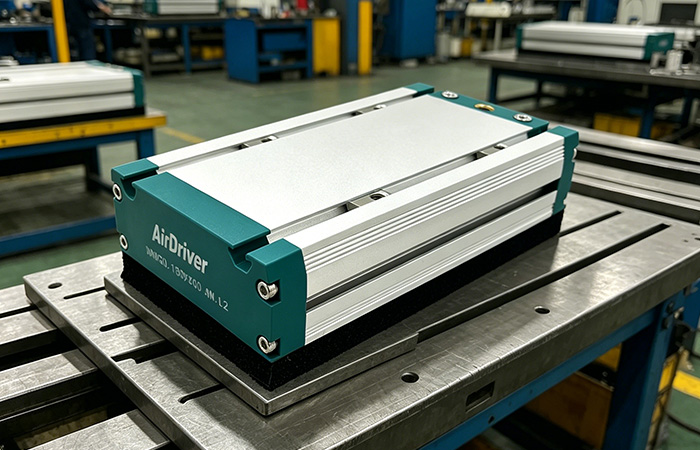
Porous surfaces are a different problem. Woven polypropylene bags, paper sacks and perforated film leak air continuously, so individual cups never reach a stable vacuum. For these loads a foam vacuum gripper is the correct answer: one large adaptive sealing face replaces dozens of cups, and a built-in generator with a one-way check valve keeps suction even when the surface is not fully covered. AirDriver ZWSA foam grippers are used for exactly this condition on robot arms handling rough, uneven and porous loads.
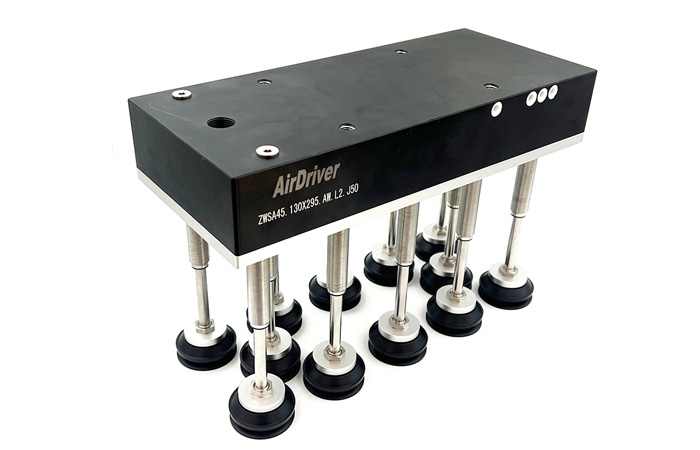
Fill-height variation adds a third variable. Pillowed pouches and overfilled bags shift the pick plane, which is why spring-mounted cup stems, or bellows with several folds, are specified on lines where pack height is not tightly controlled.
Slippage is rarely a vacuum level problem. It is a holding force problem, and holding force depends on four variables working together.
Quick sizing rule
Holding force equals friction coefficient × effective sealing area × pressure differential × safety factor. When film is wet, greasy or frosted, the friction coefficient falls and the required cup area rises. Specify for the worst case: heaviest pack, dirtiest cup, lowest supply pressure, fastest acceleration.
Practical mitigations: check valves per cup row, a small vacuum reservoir mounted close to the tool, dual-circuit monitoring, and cup replacement scheduled by cycle count rather than by failure.
The usual causes of gradual vacuum loss are worn cup lips, a blocked filter, an undersized generator, leaking fittings, and cup arrays that are larger than the available flow can support. Note the second one carefully: a blocked filter presents exactly like a weak generator, and teams replace the generator when they only needed a filter.
Material selection is the first hygiene decision. Food-grade silicone is the default where the tool contacts unwrapped food or sees elevated temperature. NBR and polyurethane are common for non-contact secondary packaging because they resist oil and abrasion at lower cost. Where the gripper does touch food, request compounds compliant with the regulation your market enforces, such as FDA 21 CFR 177.2600 or EU 1935/2004, and ask for the declaration with the quotation rather than after the order.
Standard tooling handles the straightforward majority of packs well. Custom tooling earns its cost on the formats and conditions that create downtime: the lightest film, the heaviest bag, the wettest tray and the fastest changeover. A custom robot vacuum gripper is not a luxury item; it is a response to a specific constraint on your line.
High-speed food lines rarely pick one item at a time. Multi-cup arrays lift whole trays or multipacks; multi-zone vacuum circuits let one tool pick four to twelve items and release them individually into a case; layer and row gripping handles full case packing cycles. Quick-change tooling plates then bring format changeover down to a repeatable, measurable routine.
Weight is the constraint on all of it. Lightweight frames and a generator mounted on the tool, rather than at the robot base, shorten vacuum lines, cut evacuation time and keep more of the payload budget available for product.
Build a product matrix before you specify anything. For every SKU record pack weight range, outer dimensions, surface material, friction condition, allowable contact area, pick-surface tolerance and target packs per minute. Design for the worst SKU, then verify the easiest one is not being over-gripped, which is how lightweight film gets deformed.
Adjustable or modular frames let a single tool cover a whole SKU family, which is usually the strongest economic argument for custom work. On mixed lines that handle both film pouches and heavy sacks, the practical solution is a combined frame: a cup array for the film packs and a foam gripper section for the porous bags. AirDriver supplies the heavy end of that range with a dedicated robot gripper for woven and bulk food bags used in rice, corn, flour and sugar handling, so one supplier can cover both gripping principles on the same line.
Use this checklist. If three or more apply, a custom vacuum gripping system will almost certainly return its cost.
| Signal On Your Line | Why It Points To Custom Tooling |
|---|---|
| More than three packaging formats on one cell | One standard cup set cannot seal reliably across all of them |
| Daily or weekly format changeovers | Quick-change plates and modular frames recover real production hours |
| Flexible, porous or uneven fill-height products | Requires foam faces, bellows stroke or zoning that standard tooling lacks |
| Slip or damage rate above internal target | Usually a friction and contact-area problem, solved by compound and geometry |
| Washdown, chilled or high-dust environment | Needs matched IP rating, drain paths and compounds rated for the conditions |
| Retrofit onto an existing robot with limited payload | Lightweight custom frames and tool-mounted generators free up payload |
| Cups replaced far more often than planned | Wrong compound or durometer for the actual surface is the usual cause |
For a fuller cost argument, including payback periods and total cost of ownership, see our breakdown of standard versus custom vacuum suction grippers for ROI.
Need a gripper built around your packs?
Send us your product samples or pack drawings and AirDriver will recommend cup geometry, compound, vacuum zoning and generator sizing for your actual cycle time. Samples are tested before production tooling is committed.
Yes. Vacuum grippers are the default end-of-arm tooling for food packaging automation, handling pouches, cartons, trays and bags. In most applications the gripper handles the package rather than the food. Where it does contact unwrapped product, such as bakery items, specify food-grade silicone or foam compounds and match the tool ingress rating to your cleaning method.
Choose a custom gripper when one line runs several packaging formats, when products are flexible, porous or uneven in fill height, when slip or damage rates exceed target, or when changeover time is the bottleneck. If a standard cup array holds both your heaviest and lightest SKU at full speed with margin, standard tooling is usually sufficient.
Five variables decide it: cup material and durometer, effective sealing area, achievable vacuum level, the friction coefficient between cup and package surface, and robot acceleration. Supply air pressure, filter condition and cup wear change all five over time, so specify with margin and monitor each circuit with a vacuum sensor.
Vacuum gripping distributes holding force instead of clamping, which reduces crushing, tearing and scuffing on flexible packs. It handles many formats with one tool, integrates with delta, SCARA, six-axis and collaborative robots, and keeps maintenance simple, mainly cup and filter replacement. That combination is why it dominates food packaging lines.
Food packaging automation succeeds or fails at the point of contact. The robot sets the speed ceiling, but the robot vacuum gripper decides whether that speed is actually usable across every SKU you run. Get the payload budget right, treat compressed air as a process variable rather than a utility, zone and monitor the vacuum circuits, and match cup geometry and compound to the surfaces you really handle.
When those fundamentals are in place, the remaining question is simply whether standard tooling covers your formats with enough margin. If changeover time, slip or product damage is still limiting output, a custom vacuum gripping system is usually the shortest route back to a stable line.
Talk to an AirDriver automation engineer
AirDriver has manufactured pneumatic automation components since 2018, operating a 10,099 square metre plant with eight assembly lines and more than 1,000 product categories. We support food packaging projects from sample testing through to production tooling and spare parts supply.